MITOCHONDRIAL RESEARCH
SS-31
Elamipretide
A synthetic tetrapeptide studied for its interactions with cardiolipin and the inner mitochondrial membrane.
- Class
- Mitochondrial cardiolipin binder
- Vial reference
- 10 mg
- Report available
- Compound-linked · batch not supplied

Forzinity (elamipretide) received FDA accelerated approval in September 2025 to improve muscle strength in adults and children with Barth syndrome weighing at least 30 kg. Continued approval may depend on confirmatory evidence. This approval does not cover the Cybertide 10 mg research vial. FDA source
01 / COMPOUND IDENTITY
What SS-31 is
SS-31, also known as elamipretide or MTP-131, is a four-amino-acid peptide investigated in mitochondrial biology. Cardiolipin is a phospholipid enriched in the inner mitochondrial membrane, where energy-conversion processes occur.
Laboratory studies examine how SS-31 interacts with cardiolipin, membrane-associated proteins and mitochondrial function. These mechanisms do not, by themselves, establish a clinical benefit. Mechanistic study
- Peptide sequence
- D-Arg–Dmt–Lys–Phe–NH₂
- Dmt
- 2,6-dimethyltyrosine
- Product distinction
- Forzinity is a specific approved formulation; research material is not interchangeable with it.
- Reviewed
- September 12, 2026
02 / EVIDENCE LANDSCAPE
Research areas, with their limits
Separate biological mechanisms from findings in specific patient populations.
Cardiolipin & mitochondrial membranes
Cell, biochemical and animal work explores cardiolipin interactions, cytochrome c activity and mitochondrial bioenergetics. These results support research hypotheses, not general wellness claims.
Read the studyBarth syndrome
Forzinity’s accelerated approval concerns a defined population and muscle-strength endpoint. The label reports no superiority over placebo on the randomized trial’s primary walking-distance and fatigue endpoints; strength improvements were observed in the open-label extension.
Read the FDA clinical findingsPrimary mitochondrial myopathy
MMPOWER-3 did not demonstrate improvement over placebo in its primary six-minute walk and fatigue outcomes at 24 weeks. Exploratory findings do not overturn these negative primary results.
Read MMPOWER-3This evidence does not establish SS-31 as a general anti-aging, endurance, recovery or cognitive-enhancement treatment.
03 / LABORATORY PREPARATION
Research Solution Calculator
Calculate concentration and the compound amount in a defined laboratory sample.
Enter the compound amount used in your calculation. The example starts at 10 mg.
Use the final total solution volume, not simply the volume of solvent added.
- This sample contains
- 0.333333 mg
- 333.333 µg in 100 µL
- Resulting concentration
- 3.33333 mg/mL
Concentration = mass ÷ final volume
Amount per sample = concentration × sample volume
Arithmetic assumes complete dissolution and a homogeneous solution. Use product documentation and a validated laboratory method to establish solvent compatibility, stability and storage conditions. This tool does not specify a preparation protocol or establish material quality.
04 / ANALYTICAL DOCUMENTATION
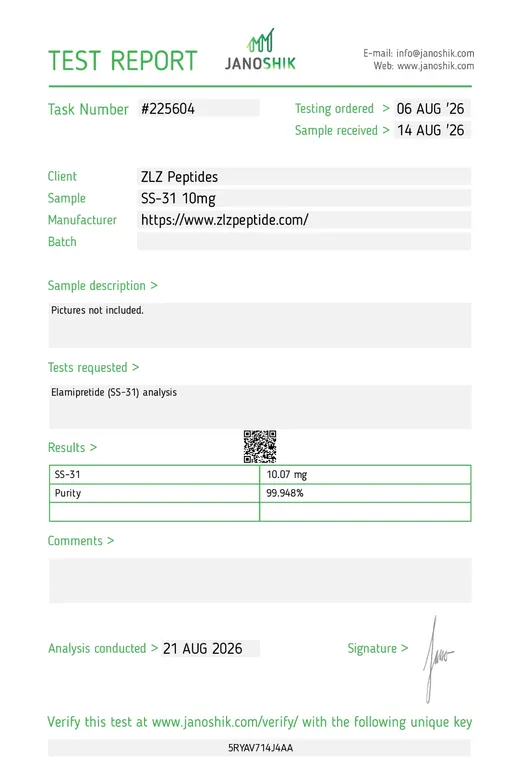
Testing / COA
The submitted laboratory document and its traceability limits, presented together.
Janoshik Analytical
Compound-linked report · 10 mg sample
- Laboratory task
- #225604
- Product lot / batch
- Not supplied on the report
- Analysis date
- August 21, 2026
- Submitted by
- ZLZ Peptides
- SS-31 content
- 10.07 mg
- Purity
- 99.948%
- Identity evidence
- Report names elamipretide (SS-31) analysis; no separate identity-method result is shown.
The blank batch field prevents exact-lot attribution to a Cybertide vial. Sterility and endotoxin results are not included. Reported purity is not a measure of clinical safety.
05 / EVIDENCE LIBRARY
Scientific sources
FDA approval announcement
Forzinity · September 19, 2025
Forzinity prescribing information
Indication, product identity, clinical findings and limitations
MMPOWER-3
Primary mitochondrial myopathy · Neurology, 2023
SS-31 interactions with cardiolipin
Inner-membrane biology and cytochrome c · JASN, 2013
Mitochondrial protein interaction landscape of SS-31
Molecular interactions · PNAS, 2020
06 / CONTINUE EXPLORING
Related research profiles
Shared research themes do not imply interchangeability or a combined-use protocol.