REDOX & ENZYME BIOLOGY
NAD+
Nicotinamide adenine dinucleotide
A cellular coenzyme involved in electron transfer, energy metabolism and the activity of NAD-dependent enzymes.
- Class
- Dinucleotide coenzyme · not a peptide
- Vial reference
- 1,000 mg
- Report available
- 500 mg only · lot 032796
The Cybertide research vial is not an FDA-approved medicine. FDA has reported reactions to injectable NAD+ products consistent with excessive endotoxin contamination. Those reports concern product quality; they do not establish efficacy or the quality of this vial. FDA source
01 / COMPOUND IDENTITY
What NAD+ is
NAD+ is the oxidized form of nicotinamide adenine dinucleotide. Together with its reduced form, NADH, it participates in electron-transfer reactions central to cellular metabolism.
NAD+ is also consumed by enzymes involved in signaling and DNA-repair pathways. Cells synthesize and recycle it through multiple pathways. Its essential biological role does not mean that adding more, by any route, necessarily improves health.
NR (nicotinamide riboside) and NMN (nicotinamide mononucleotide) are precursors, not interchangeable names for NAD+. A study of one substance or route cannot be treated as proof for another.
- Molecular category
- Coenzyme composed of two linked nucleotides
- Redox pair
- NAD+ / NADH
- Evidence distinction
- Cell biology · direct NAD+ administration · precursor supplementation
- Reviewed
- September 12, 2026
02 / EVIDENCE LANDSCAPE
Research areas, with their limits
Distinguish biological function, changes in measured metabolites and demonstrated clinical outcomes.
Fate of administered NAD+
A small 2019 study tracked plasma and urine metabolites during and after NAD+ infusion. It explored metabolism and handling of the compound, rather than establishing anti-aging, cognitive or recovery benefits.
Read the metabolism studyTolerability & short-term observations
A 2026 review of commercial-clinic records compared NAD+ and NR infusions. NAD+ recipients reported gastrointestinal symptoms, increased heart rate and chest pressure during infusion. This nonrandomized, short follow-up study does not establish long-term safety or effectiveness.
Read the 2026 pilotRaising measured NAD+ levels
A randomized crossover trial studied oral nicotinamide riboside in middle-aged and older adults and found increased NAD+ levels. That is evidence about an oral precursor and a biomarker—not proof of clinical benefits from an NAD+ research vial.
Read the precursor trialThese studies do not establish this material as an anti-aging, energy, cognitive-enhancement or recovery treatment. Findings depend on the substance, formulation, route and population studied.
03 / LABORATORY PREPARATION
Research Solution Calculator
Calculate concentration and compound amount in a laboratory sample. The editable example starts at the 1,000 mg vial reference.
Enter the compound amount used in your calculation. The example starts at 1000 mg.
Use the final total solution volume, not simply the volume of solvent added.
- This sample contains
- 33.3333 mg
- 33,333.3 µg in 100 µL
- Resulting concentration
- 333.333 mg/mL
Concentration = mass ÷ final volume
Amount per sample = concentration × sample volume
This is arithmetic, not a validated preparation method. Volume shortcuts do not establish solubility, vial capacity, pH, stability or solvent compatibility. Use the final total solution volume and a validated laboratory method. Selecting 500 mg does not connect a vial to the report below.
04 / ANALYTICAL DOCUMENTATION
Testing / COA
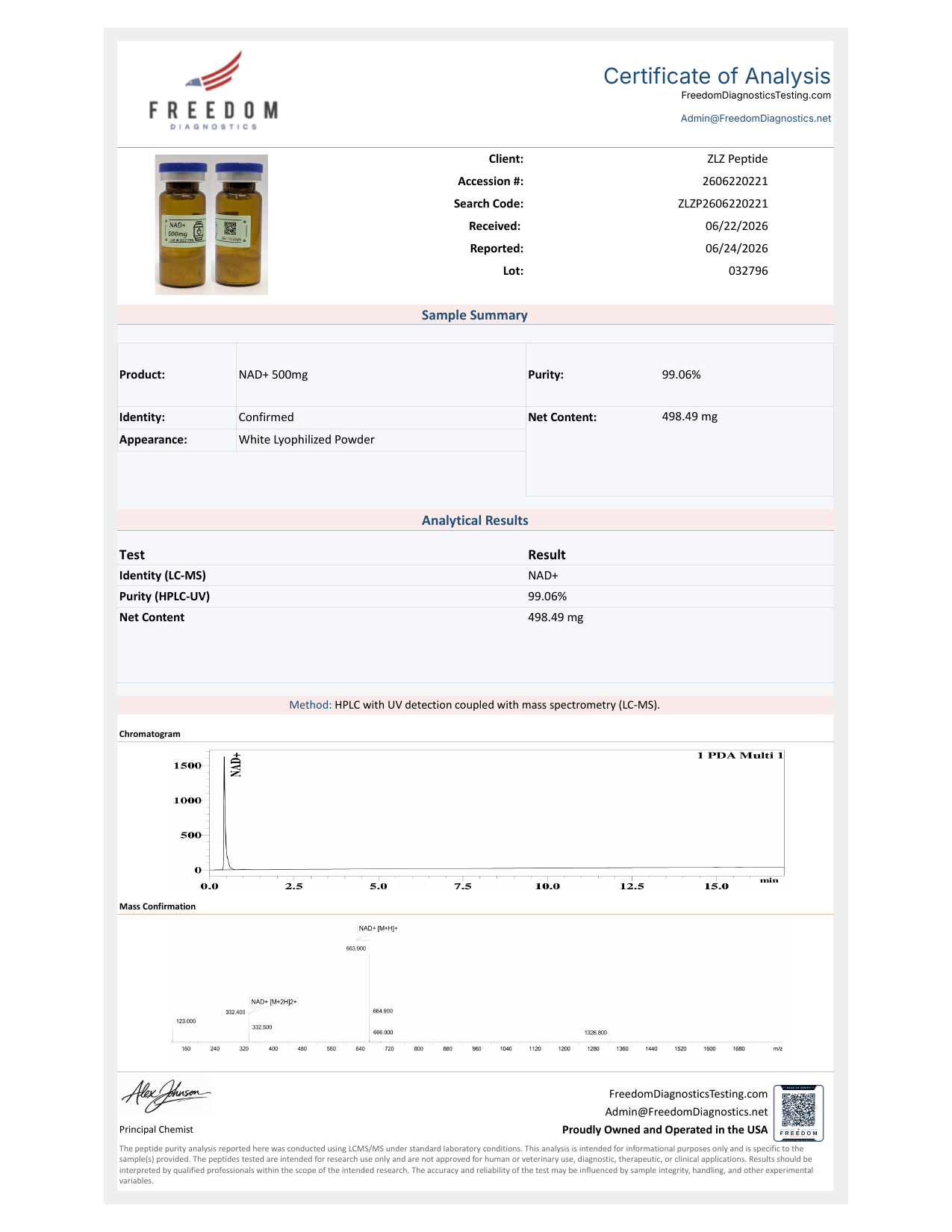
No report for the 1,000 mg vial is currently supplied. The available document concerns a separate 500 mg sample.
500 mg / Freedom Diagnostics
Report identifies lot 032796 · 500 mg sample
- Accession number
- 2606220221
- Reported lot
- 032796
- Reported date
- June 24, 2026
- Submitted by
- ZLZ Peptide
- Identity
- Confirmed - NAD+ · LC-MS
- Purity
- 99.06% · HPLC-UV
- Net content
- 498.49 mg
This 500 mg report does not verify the 1,000 mg vial. Connecting a report to material requires matching lot and documented provenance. Sterility and endotoxin results are not included; reported purity is not a measure of clinical safety.
05 / EVIDENCE LIBRARY
Scientific sources
FDA sterile-compounding reminder
NAD+ ingredients, microbial contamination and endotoxin concerns
NAD+ infusion & the plasma/urine metabolome
Grant et al. · Frontiers in Aging Neuroscience, 2019
NAD+ versus NR infusion tolerability
Reyna et al. · Frontiers in Aging, 2026
Nicotinamide riboside & NAD+ levels
Martens et al. · Nature Communications, 2018
06 / CONTINUE EXPLORING
Related research profiles
Shared research themes do not imply interchangeability or a combined-use protocol.