MITOCHONDRIAL SIGNALING
MOTS-c
Mitochondrial-derived peptide
A 16-amino-acid peptide studied for its role in cellular stress responses, metabolic signaling and communication with the nucleus.
- Class
- Mitochondrial signaling peptide
- Vial reference
- 40 mg
- Reports available
- 40 mg · batch not supplied
10 mg · lot 071063

This research vial is not an FDA-approved medicine. FDA identifies potential immune-response risks and gaps in human exposure and safety data for compounded MOTS-c. Laboratory and animal findings do not establish clinical safety or efficacy. FDA source
01 / COMPOUND IDENTITY
What MOTS-c is
MOTS-c is a short peptide encoded by an open reading frame within the mitochondrial 12S ribosomal RNA gene. Its name refers to “mitochondrial open reading frame of the 12S rRNA type-c.”
In cell experiments, MOTS-c can relocate to the nucleus during metabolic stress and influence gene expression through pathways involving AMPK, a cellular energy sensor. These observations help explain a research mechanism; they do not establish a treatment effect. Mechanistic study
- Peptide length
- 16 amino acids
- Research themes
- Metabolic regulation · cellular stress · skeletal muscle biology
- Key distinction
- Measurements of naturally occurring MOTS-c are not trials of a supplied research vial.
- Reviewed
- September 12, 2026
02 / EVIDENCE LANDSCAPE
Research areas, with their limits
Human observations, animal experiments and cellular mechanisms answer different questions.
Cellular stress & gene regulation
Experiments examine stress-dependent nuclear relocation, AMPK signaling and changes in stress-responsive gene expression. A mechanism observed in cells does not demonstrate a benefit in people.
Read the cell studyMuscle function & metabolic adaptation
A 2021 study tested administered MOTS-c in mice and reported changes in physical performance and metabolic adaptation. These findings do not establish human performance, weight-loss or longevity benefits.
Read the animal findingsNaturally occurring MOTS-c
The same study measured endogenous MOTS-c in human muscle and circulation around exercise. Participants were not receiving MOTS-c treatment; the results cannot show that taking MOTS-c reproduces exercise benefits.
Read the human observationsThe evidence summarized here does not establish MOTS-c as a treatment for obesity, diabetes, aging or impaired exercise performance. Human safety and clinical efficacy remain unresolved.
03 / LABORATORY PREPARATION
Research Solution Calculator
Calculate concentration and compound amount in a defined laboratory sample. The editable example uses the 40 mg vial reference.
Enter the compound amount used in your calculation. The example starts at 40 mg.
Use the final total solution volume, not simply the volume of solvent added.
- This sample contains
- 1.33333 mg
- 1,333.33 µg in 100 µL
- Resulting concentration
- 13.3333 mg/mL
Concentration = mass ÷ final volume
Amount per sample = concentration × sample volume
Arithmetic assumes complete dissolution and a homogeneous solution. Establish solvent compatibility, stability and storage using product documentation and a validated laboratory method. A 10 mg sample requires its own mass input; the reports below are not interchangeable.
04 / ANALYTICAL DOCUMENTATION
Testing / COA
Two submitted reports, separated by labeled amount and traceability. Match the strength and lot to the material being assessed.
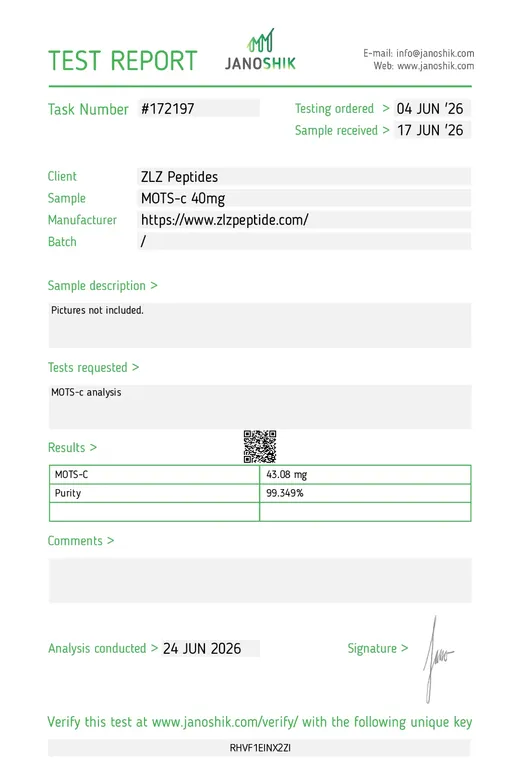
40 mg / Janoshik Analytical
Compound-linked report · no usable batch identifier
- Laboratory task
- #172197
- Product lot / batch
- Not supplied — report field contains /
- Analysis date
- June 24, 2026
- Submitted by
- ZLZ Peptides
- MOTS-c content
- 43.08 mg
- Purity
- 99.349%
- Identity evidence
- Report names MOTS-c analysis; no separate identity-method result is shown.
Without a usable batch identifier, this report cannot be assigned to an exact Cybertide vial lot. Sterility and endotoxin results are not included. Purity is not a measure of clinical safety.
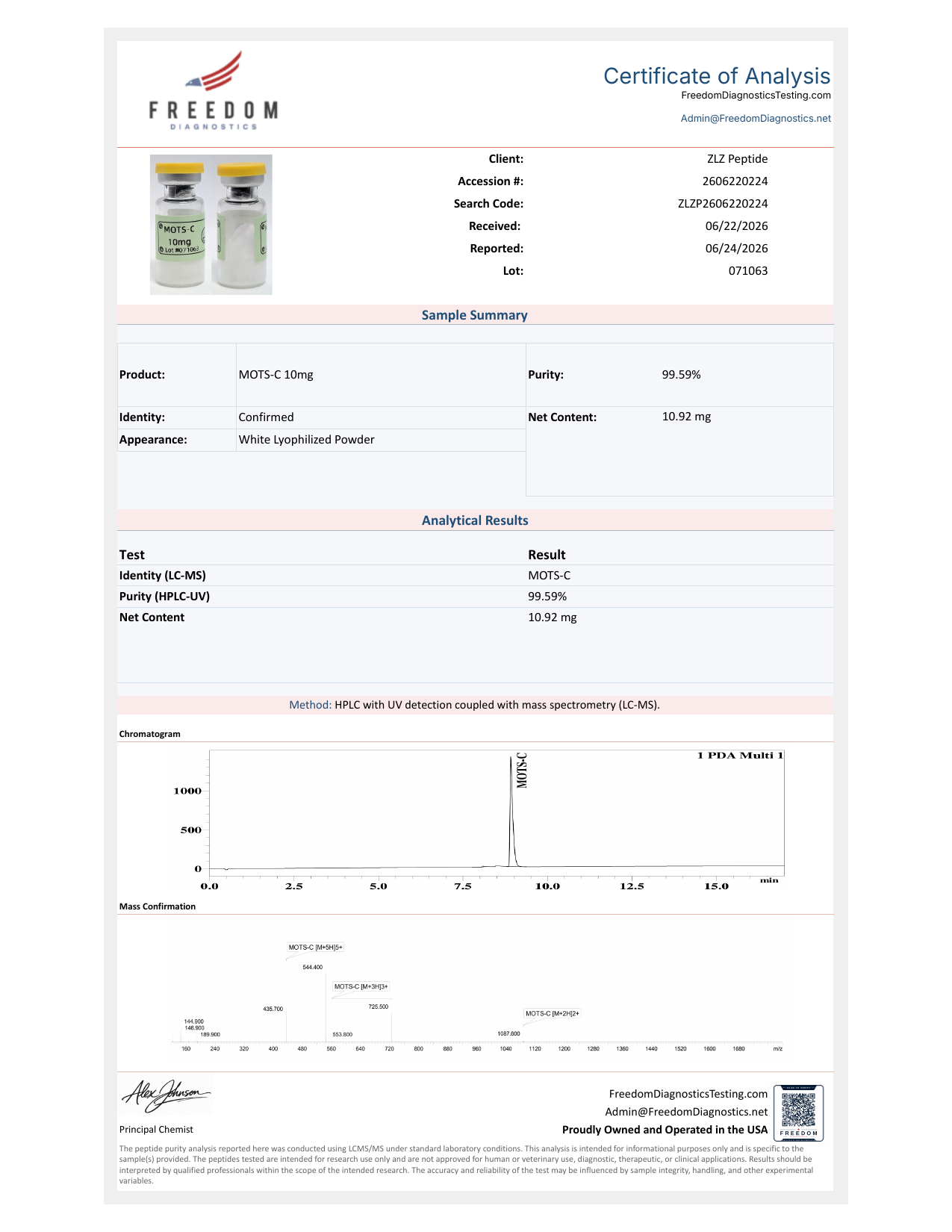
10 mg / Freedom Diagnostics
Report identifies lot 071063 · 10 mg sample
- Accession number
- 2606220224
- Product lot / batch
- 071063
- Reported date
- June 24, 2026
- Submitted by
- ZLZ Peptide
- Identity
- Confirmed - MOTS-C · LC-MS
- Purity
- 99.59% · HPLC-UV
- Net content
- 10.92 mg
This report concerns a 10 mg sample and does not verify the 40 mg material. A matching lot and documented provenance are required to connect it to a particular vial. Sterility and endotoxin results are not included. Purity is not a measure of clinical safety.
05 / EVIDENCE LIBRARY
Scientific sources
FDA compounding safety assessment
MOTS-c entry · limitations in human exposure and safety data
Metabolic stress & nuclear gene regulation
Kim et al. · Cell Metabolism, 2018
Exercise, muscle biology & MOTS-c
Reynolds et al. · Nature Communications, 2021
06 / CONTINUE EXPLORING
Related research profiles
Shared research themes do not imply interchangeability or a combined-use protocol.