CELLULAR REDOX BIOLOGY
Glutathione
Endogenous tripeptide antioxidant
A three-amino-acid compound made by cells and studied for its roles in redox balance, peroxide metabolism and cellular stress responses.
- Class
- Glutamate–cysteine–glycine tripeptide
- Vial reference
- 1,600 mg
- Report available
- 600 mg only · batch not supplied
The Cybertide research vial is not an FDA-approved medicine. FDA documented adverse events and excessive endotoxin in ingredients used for compounded glutathione injections. This is product-quality context, not evidence of contamination in the material shown here or proof of clinical benefit. FDA source
01 / COMPOUND IDENTITY
What glutathione is
Glutathione is a tripeptide composed of glutamate, cysteine and glycine, with an unusual gamma-glutamyl linkage. Its reduced form is commonly abbreviated GSH; two glutathione units linked by a disulfide form oxidized glutathione, GSSG.
Cellular enzyme systems use and recycle glutathione during peroxide handling and other redox reactions. Researchers study these processes using measurements such as glutathione concentrations and the balance between reduced and oxidized forms.
Its normal role in cells does not establish that a particular supplement or research formulation improves health. The route, formulation and outcome measured matter.
- Constituent amino acids
- Glutamate · cysteine · glycine
- Redox forms
- GSH / GSSG
- Research themes
- Peroxide metabolism · redox signaling · cellular antioxidant systems
- Reviewed
- September 12, 2026
02 / EVIDENCE LANDSCAPE
Research areas, with their limits
Biomarker findings vary across studies. They should not be treated as interchangeable with clinical outcomes.
Short-term biomarker findings
A four-week placebo-controlled trial in healthy adults found no significant improvement in the measured oxidative-stress biomarkers or glutathione status. This result applies to the oral intervention and study conditions tested.
Read the 2011 trialLonger-term glutathione stores
A separate six-month trial reported increases in glutathione in several sampled body compartments. Changes in measured stores do not, by themselves, establish disease prevention, longer lifespan or benefits from an injectable formulation.
Read the 2015 trialPurity & contamination are different questions
FDA’s investigation found excessive bacterial endotoxin in glutathione ingredients used to compound sterile injections. A chemical-purity result alone cannot establish sterility, endotoxin control or suitability for a particular use.
Read the FDA investigationThe studies summarized here do not validate this research vial for detoxification, skin lightening, anti-aging or recovery. Different trial durations and methods also prevent a simple one-to-one comparison of results.
03 / LABORATORY PREPARATION
Research Solution Calculator
Calculate concentration and compound amount in a laboratory sample. The editable example starts at the 1,600 mg vial reference.
Enter the compound amount used in your calculation. The example starts at 1600 mg.
Use the final total solution volume, not simply the volume of solvent added.
- This sample contains
- 53.3333 mg
- 53,333.3 µg in 100 µL
- Resulting concentration
- 533.333 mg/mL
Concentration = mass ÷ final volume
Amount per sample = concentration × sample volume
This is arithmetic, not a validated preparation method. Volume shortcuts do not establish solubility, vial capacity, pH, stability or solvent compatibility. Calculations assume complete dissolution and a homogeneous solution. Use the final total solution volume and a validated laboratory method.
04 / ANALYTICAL DOCUMENTATION
Testing / COA
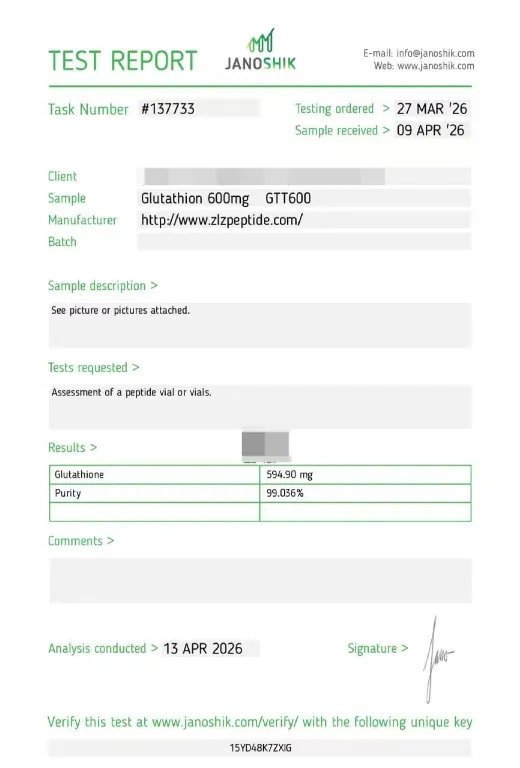
No report for the 1,600 mg vial is currently supplied. The available document concerns a separate 600 mg sample without a batch identifier.
600 mg / Janoshik Analytical
Compound-linked report · no exact-lot attribution
- Laboratory task
- #137733
- Product lot / batch
- Not supplied on the report
- Analysis date
- April 13, 2026
- Submitted by
- Client name obscured in the submitted image
- Glutathione content
- 594.90 mg
- Purity
- 99.036%
- Identity evidence
- Glutathione is named in the results; no separate identity-method result is shown.
This 600 mg report does not verify the 1,600 mg vial. The missing batch identifier prevents exact-lot attribution. Sterility and endotoxin results are not included; reported purity is not a measure of clinical safety.
05 / EVIDENCE LIBRARY
Scientific sources
FDA glutathione compounding investigation
Ingredient suitability, contamination and endotoxin findings
Four-week oxidative-stress biomarker trial
Allen & Bradley · Journal of Alternative and Complementary Medicine, 2011
Six-month glutathione body-stores trial
Richie et al. · European Journal of Nutrition, 2015
06 / CONTINUE EXPLORING
Related research profiles
Shared research themes do not imply interchangeability or a combined-use protocol.